Harsh times for energy markets amid a historical natural gas shortage
The EnergyScan team held its quarterly webinar covering key trends and events on energy markets. In this webinar, our experts addressed the following topics, with…

European gas prices increased again yesterday, mainly supported by rising tensions on the Ukrainian border. The rise in Asia JKM prices (+13.70% on the spot, to €80.737/MWh; +1.68% for the March 2022 contract, to €75.110/MWh; +3.65% for the April 2022 contract, to €80.588/MWh) helped accompany the bullish momentum as it suggests stronger competition between Europe and Asia to attract the flexible LNG cargoes. On the spot pipeline supply side, Russian flows increased to 203 mm cm/day on average yesterday, compared to 191 mm cm/day on Friday. Norwegian flows were almost stable, averaging 334 mm cm/day, compared to 333 mm cm/day on Friday.
At the close, NBP ICE March 2022 prices increased by 7.160 p/th day-on-day (+3.85%), to 193.020 p/th. TTF ICE March 2022 prices were up by €3.35 (+4.32%), closing at €80.771/MWh. On the far curve, TTF ICE Cal 2023 prices were up by €1.91 (+3.54%), closing at €55.805/MWh.
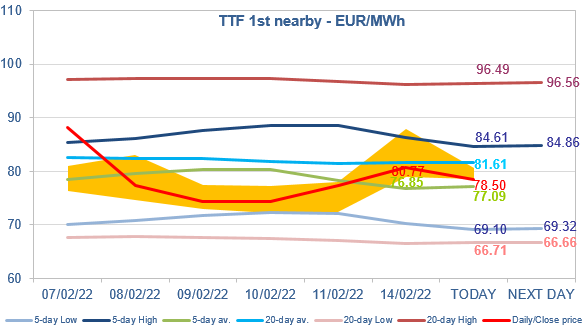
TTF ICE March 2022 prices did not manage to break the resistance of the 5-day High yesterday, finally closing between the 5-day average and the 20-day average. They are slightly down this morning. But, given the yesterday rise in Asia JKM prices, their downside potential seems limited and they could trade today between the 5-day average and the 5-day High. if the geopolitical situation deteriorates further, prices could rise towards the 20-day High.