Energy markets remain firmly supported as geopolitical tensions in the Middle East intensify, pushing oil prices above $105/b. At the same time, gas and power markets are reacting to a combination of geopolitical uncertainty, weather dynamics, and macroeconomic signals. The current environment highlights growing duration risk across commodities rather than immediate supply shocks.
Oil Markets: Geopolitical Risk Drives Prices Higher
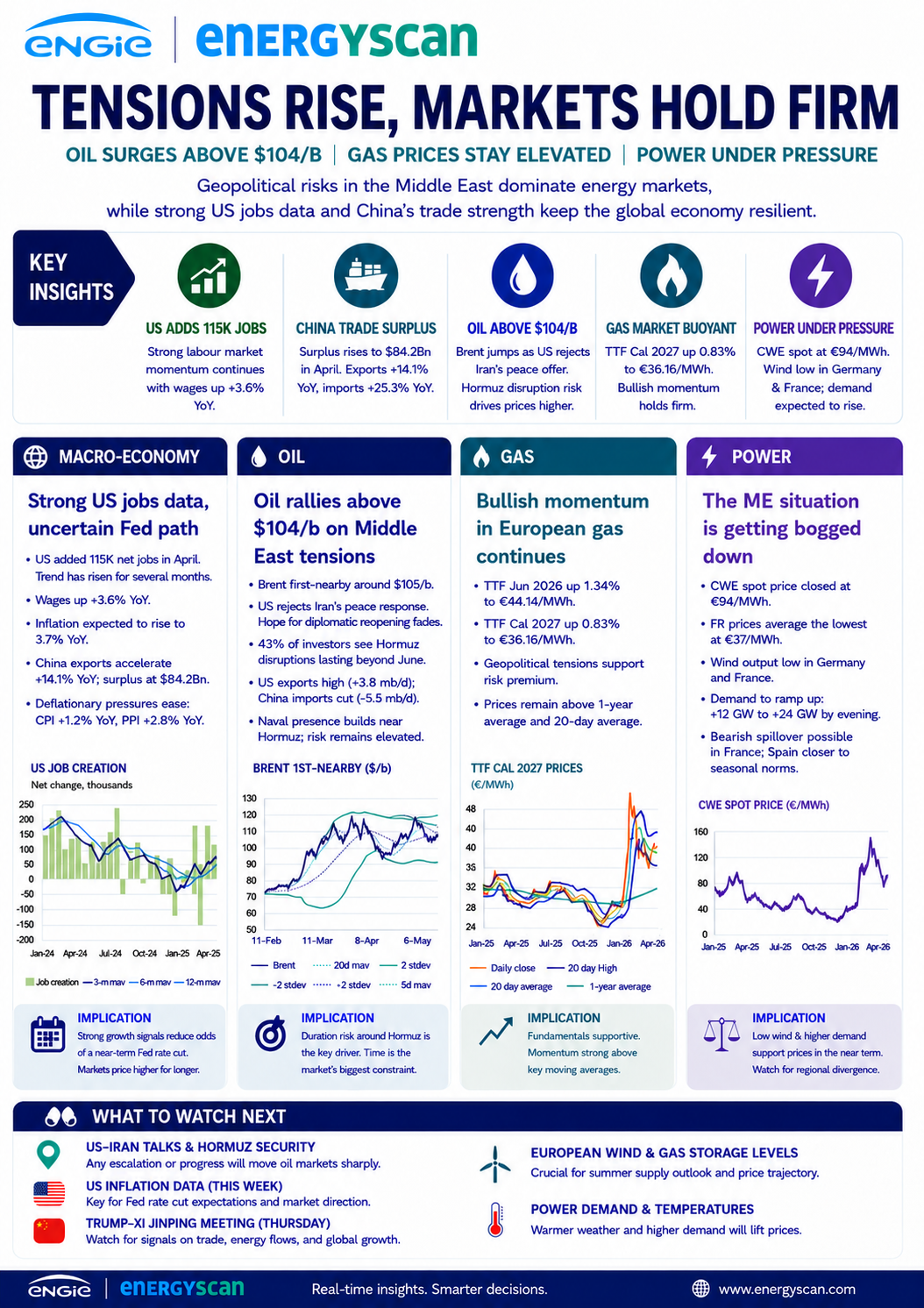
Brent crude prices have rebounded sharply, moving from $100/b to around $105/b, as markets reassess geopolitical risks in the Middle East. The rejection of Iran’s latest response to US peace proposals has effectively removed near-term expectations of de-escalation, reinforcing concerns around the Strait of Hormuz.
Oil prices reopened above $104/b, reflecting increased risk premiums linked to potential prolonged disruption of this critical shipping route. The current market dynamic is not driven by new outages but by fears over how long constraints could persist. Time has become the central factor shaping market expectations.
Political signals have further reinforced the upside risk. Both the US and Iran have rejected each other’s proposals, with no clear pathway toward reopening Hormuz. Shipping incidents in the region, including a drone strike near Qatar, have highlighted the fragility of the situation.
Investor sentiment has shifted accordingly. A majority now expect disruptions to extend beyond June, with a significant share anticipating normalization only after July. Despite these concerns, expectations for year-end prices remain more moderate, with some market participants forecasting Brent in the $80–$90/b range.
The broader supply-demand balance has so far cushioned price increases. Elevated US exports and reduced Chinese imports have offset more than 9 mb/d of tightening. However, this flexibility may not be sustainable indefinitely, raising questions about how long current export levels can be maintained without impacting domestic balances.
Gas Markets: Bullish Momentum Persists
European gas prices continue to show resilience, supported by geopolitical tensions and stable underlying fundamentals. TTF June 2026 prices rose to €44.143/MWh, while longer-dated contracts also edged higher.
The recent rebound follows earlier declines triggered by temporary optimism around a potential peace agreement. However, as negotiations stalled, prices recovered and moved back above key technical levels, reinforcing the view that the bullish trend remains intact.
Global dynamics are also influencing the market. Asian LNG prices increased slightly, narrowing the premium over European prices. Meanwhile, US gas prices moved in the opposite direction, with Henry Hub declining modestly.
Coal prices also experienced moderate gains, reflecting broader upward pressure across energy commodities. The overall picture points to a market still anchored by geopolitical uncertainty rather than demand-side changes.
Power Markets: Weather and Supply Shape Price Dynamics
European power markets are being shaped by a combination of weather conditions and renewable generation patterns. The CWE average spot price closed at €94/MWh, with French prices significantly lower at €37/MWh.
Below-average temperatures across Northwest Europe are supporting demand, with deviations of up to -5°C observed in several countries. This has contributed to a firmer demand outlook, particularly in key markets such as Germany and France.
On the supply side, renewable generation remains mixed. German wind output is expected to increase throughout the day, while solar generation remains below normal in France and relatively subdued in Germany. Spain, however, is closer to seasonal norms, creating some downward pressure on French prices.
Looking ahead, stronger wind and solar output, combined with increased hydro generation due to wetter conditions, are expected to weigh on power prices. However, these bearish factors may be offset by rising fuel costs linked to higher oil and gas prices.
Macro and Carbon Context: Mixed Signals
Macroeconomic indicators provide a mixed backdrop for energy markets. Strong US labour market data, including 115,000 job creations and wage growth of 3.6% year-on-year, supports economic resilience but reduces expectations of a near-term rate cut.
At the same time, inflation is expected to rise further, complicating monetary policy expectations. In China, export growth remains robust, while deflationary pressures continue to ease as both consumer and producer prices show upward momentum.
In Europe, German industrial production contracted by 2.8% year-on-year, highlighting ongoing weakness in manufacturing. This deterioration, combined with geopolitical uncertainty, could weigh on industrial demand and emissions.
Carbon prices edged lower, reflecting a wait-and-see approach among market participants. The absence of geopolitical clarity continues to limit directional conviction, leaving the market sensitive to external developments.
Key Takeaways
- Oil prices remain supported above $105/b, driven by prolonged geopolitical uncertainty and duration risk around the Strait of Hormuz.
- European gas markets maintain bullish momentum despite stable fundamentals, as geopolitical risks dominate pricing.
- Power markets are balancing weather-driven demand with renewable supply, while macro signals remain mixed.
Conclusion
Energy markets are increasingly driven by geopolitical duration risk rather than immediate supply disruptions. With no clear resolution in the Middle East and macroeconomic signals diverging, price volatility is likely to persist across oil, gas, and power markets.