Oil Surplus Risk Builds as Gas and Carbon Prices Stay Firm
Macro backdrop: equities rebound, yields rise
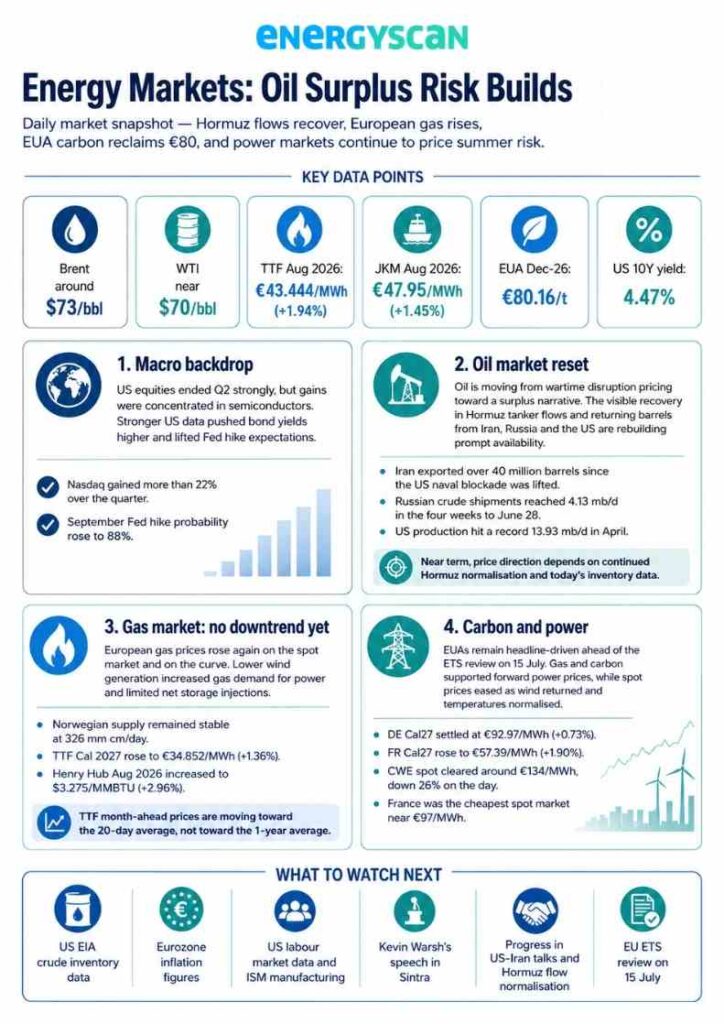
US equity markets ended the second quarter strongly, with the Nasdaq gaining more than 22% over the quarter and the S&P 500 nearly 15%. However, the performance was concentrated in semiconductors, while software stocks remained under pressure from the rapid rise of AI.
This raises questions about the underlying strength of the US economy outside AI-linked sectors and data centre construction. May household consumption figures were reassuring, helped by lower energy prices, and job vacancies returned to their highest level in two years.
The stronger US data pushed bond yields higher. The probability of a Fed rate rise as early as September rose to 88%, while the market remains split on a second rise in December. The US 10-year yield moved close to 4.5%, but the dollar failed to break sustainably through the 1.14 support level against the euro.
In Europe, inflation figures for the main eurozone countries came in below expectations in June. Eurozone inflation data, US labour market indicators, the ISM manufacturing index and Kevin Warsh’s speech in Sintra are the main macro signals to watch.
Oil: from Hormuz scarcity to surplus risk
Brent steadied around $73/bbl this morning, after falling nearly 30% over the past quarter. WTI held near $70. The oil market is now moving away from wartime disruption pricing and repricing toward a normalisation of physical flows through the Strait of Hormuz.
The main driver is the visible recovery in tanker traffic following US-Iran de-escalation. Positive discussions in Doha and expectations that technical talks could extend beyond the initial 60-day window are reinforcing the shift in market perception.
Supply flows are already adjusting. Iran reported exports of more than 40 million barrels since the US naval blockade was lifted, after shipping no barrels during the previous 60 days. Russian crude shipments also rose to 4.13 mb/d in the four weeks to June 28, the highest level since 2022. US production reached a record 13.93 mb/d in April, while total oil and product exports reached 13.6 mb/d.
This return of supply from Iran, Russia and the US is rebuilding prompt availability and weakening the scarcity narrative. Forward balances are also deteriorating, with Goldman Sachs seeing a surplus close to 2 mb/d in 2027 after accounting for SPR restocking.
However, inventories remain important for short-term price direction. API estimates showed US commercial crude stocks falling by 6.072 million barrels last week, while official EIA data is expected to show a smaller crude draw of around 3.1 million barrels. Confirmation of another draw could temporarily cushion the surplus narrative.
Gas: no clear downtrend yet
European gas prices increased again, both on the spot market and the forward curve. TTF August 2026 rose by 1.94% to €43.444/MWh, while TTF Cal 2027 gained 1.36% to €34.852/MWh.
Stable Norwegian supply did not prevent tighter conditions, as lower wind generation lifted gas demand for power generation and limited European net storage injections. Asian gas prices also increased, with JKM August 2026 rising to €47.95/MWh.
This morning, European gas prices continued to rise, with TTF August 2026 at €43.98/MWh and TTF Cal 2027 at €35.05/MWh. With TTF month-ahead prices moving toward their 20-day average rather than falling toward their one-year average, the market does not appear ready to enter a downtrend.
Power and carbon: ETS policy drives volatility
The EUA Dec26 contract reclaimed the €80 level and closed at €80.16/t. EUAs remain highly headline-driven ahead of the ETS review scheduled for 15 July.
The market reacted upward after clarification from a senior European People’s Party member involved in EU ETS reform negotiations. No safety clause for the power sector was proposed in the EPP report in case of a new energy crisis, which the market interpreted as a bullish signal.
Power forwards also moved higher, supported by the rebound in gas and carbon. DE Cal27 settled at €92.97/MWh, while FR Cal27 rose to €57.39/MWh as buyers repriced summer risks.
On the spot side, CWE cleared around €134/MWh for delivery today, down 26% on the day. Prices are expected to fall further as wind returns in western Europe and demand declines with normalising temperatures.
Key takeaways
- Oil markets are shifting from Hormuz scarcity pricing toward surplus risk as physical flows recover.
- European gas prices are not yet in a downtrend, supported by power-sector demand and limited storage injections.
- EUA carbon and power forwards remain sensitive to ETS policy signals, gas prices and summer risk repricing.
Conclusion
The daily market picture is no longer defined by a single energy shock. Oil is increasingly pricing normalisation and future surplus, while European gas, carbon and power markets remain supported by tighter short-term fundamentals and political uncertainty.