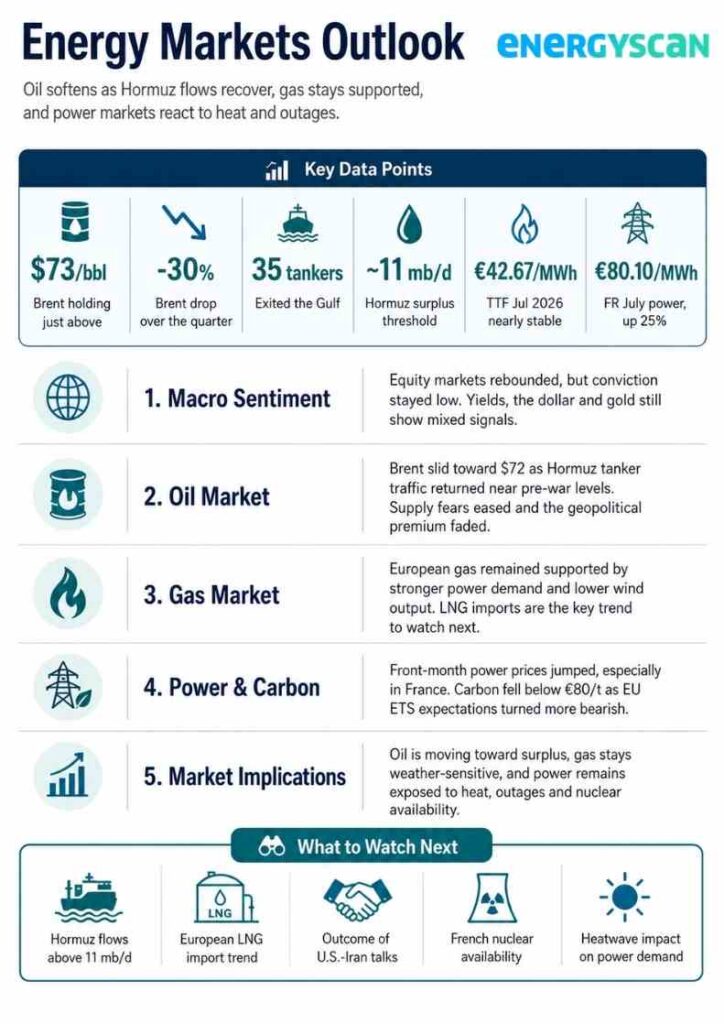
Oil Prices Slide Toward $72 as Markets Adjust to Rising Supply
Global oil markets continue to lose momentum as Brent crude moves closer to $72 per barrel, reflecting easing geopolitical concerns and improving supply conditions.
The primary driver behind the latest decline is the rapid recovery of tanker traffic through the Strait of Hormuz, one of the world’s most strategic energy shipping routes. Shipping volumes have largely returned to pre-conflict levels, significantly reducing fears of supply disruptions.
According to market observations, approximately 35 oil and gas tankers recently exited the Gulf, bringing daily flows close to the levels seen before the regional tensions escalated. As physical supply normalizes, the geopolitical risk premium embedded in crude prices continues to fade.
Brent Outlook Turns More Bearish
The normalization of exports is prompting analysts to revise their oil price outlook.
Market expectations now suggest that once Hormuz flows consistently exceed around 11 million barrels per day, the global oil market could shift back into surplus. This has already led to lower Brent price forecasts for the second half of the year.
Additional bearish signals include:
- Saudi Arabia expected to reduce August official selling prices (OSPs) for Asian buyers.
- Growing supertanker availability across the Gulf region.
- A widening contango structure in oil futures, indicating ample short-term supply.
Despite ongoing security risks in the region, energy shipments have remained resilient, limiting further upside potential for crude prices.
European Gas Prices Supported by Power Demand
While oil prices have weakened, European natural gas prices remain relatively firm.
Gas demand increased as lower wind generation forced greater reliance on gas-fired power plants, pushing spot prices higher. At the same time, Asian LNG prices also strengthened, although the premium over European prices narrowed slightly.
Looking ahead, one of the key market indicators will be the pace of European LNG imports. Traders will closely monitor whether LNG deliveries accelerate enough to replenish storage ahead of winter while remaining competitive with Asian demand.
Golden Pass LNG Facility Remains Under Watch
Another important development comes from the United States.
The Golden Pass LNG export terminal, a joint venture between QatarEnergy and ExxonMobil, appears to have temporarily reduced natural gas intake during its commissioning process.
Although start-up interruptions are common for new LNG facilities, Golden Pass is expected to become one of the largest U.S. export terminals, with an annual export capacity exceeding 24 bcm once fully operational. Future progress at the terminal could influence global LNG supply expectations.
European Power Markets Surge Despite Falling Carbon Prices
European electricity markets experienced significant price movements, particularly in front-month contracts.
France’s July baseload power contract surged by around 25% in a single session, supported by unexpected nuclear reactor outages and increasing concerns over summer electricity supply.
Meanwhile, carbon prices declined sharply after discussions around possible reforms to the EU Emissions Trading System (EU ETS). Proposals to slow the reduction of emissions allowances raised expectations of increased carbon supply, putting downward pressure on EU carbon prices.
Despite weaker carbon prices, stronger gas markets helped support longer-term electricity contracts across France and Germany.
Weather Remains the Key Driver for Power Prices
Weather forecasts continue to dominate short-term power market expectations.
A developing heatwave across France and parts of Central Europe is expected to increase electricity demand for cooling. At the same time:
- Wind generation is forecast to weaken after the weekend.
- Hydro conditions remain relatively dry.
- Several French nuclear reactors are gradually returning to service following temporary restrictions caused by high river temperatures.
These factors are likely to keep short-term electricity markets volatile as traders balance improving nuclear availability against stronger seasonal demand.
Market Outlook
Energy markets are entering a new phase where supply fundamentals are gradually replacing geopolitical risk as the dominant pricing factor.
Oil prices continue to soften as exports through the Strait of Hormuz normalize, while European gas markets remain supported by weather-driven power demand. Electricity markets, meanwhile, are increasingly influenced by carbon policy developments, nuclear availability, and evolving summer weather patterns.
In the coming weeks, investors will closely watch LNG import trends, Middle East diplomacy, and European weather forecasts for the next signals shaping oil, gas, and power prices.